Person
Meister Eckhart
Dominican preacher and Christian mystic
Detachment is the doorway Meister Eckhart returns to: loosening the grip of images, self-will, and possession so that the Word can be born in the soul. Eckhart (c. 1260–1328) was a German Dominican preacher in the medieval Catholic Church. His sermons sometimes call the depth beyond our concepts of God the Godhead.
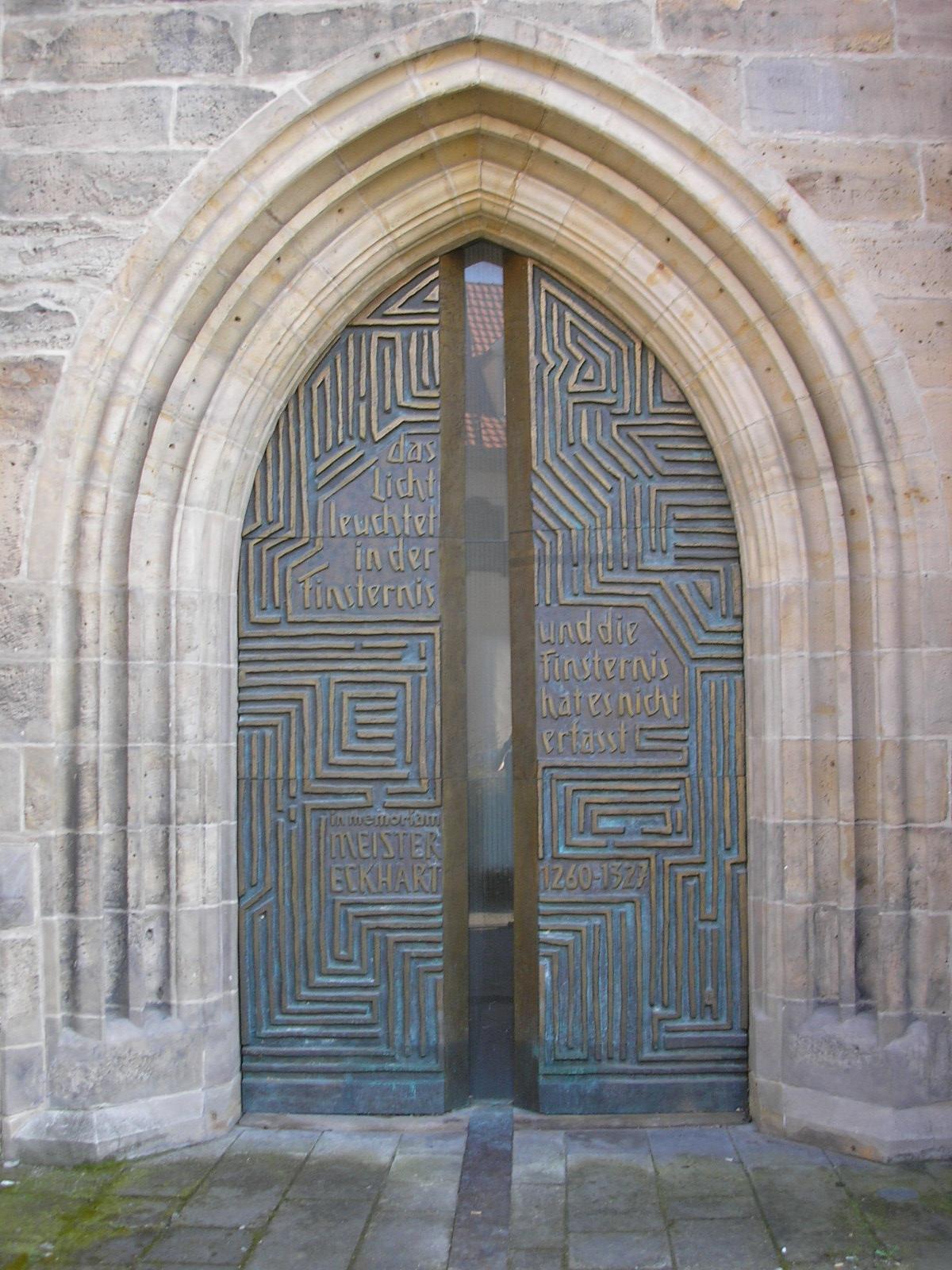
Eckhart preached in German and wrote in Latin, addressing nuns and laypeople as well as scholars. Some sermons bring the soul’s seeing and God’s seeing startlingly close. Their movement is inward, but not toward a private possession: as attachment loosens, the familiar division between the seeker and the God being sought becomes harder to state in ordinary language.
He taught in Paris and Cologne and served as prior of the Dominican house in Erfurt. After his death, a papal bull issued in 1329 condemned propositions associated with his teaching; Eckhart had appealed to the pope but did not live to hear the judgment. Scholars continue to ask how those propositions relate to the sermons and how his strongest language of union handles the distinction between creature and Creator.
The Godhead names the point at which familiar God-language reaches its limit, while the birth of the Word in the soul gives that limit a specifically Christian form. Eckhart remains a preacher of Trinity, incarnation, grace, and prayer. His language can approach the intensity of non-dual teaching, but it does so through the relation between God and the soul rather than through Shankara’s account of Atman and Brahman.
Words used here
Plain meanings for words on this page.
theology
The disciplined study and articulation of claims about God, the sacred, and ultimate reality within a religious tradition. Theology works from scripture, practice, and community. It does not hand you a single universal definition of “God.”
A little deeper
Theology and philosophy overlap, and they still do different jobs. A theologian may speak from within a tradition’s commitments; a philosopher may ask about first causes or being without accepting revelation. Both can use the word God and mean different things.
non-duality
The idea that the separation we normally experience between “me” and “everything else” is not the deepest level of reality.
Featured connections
Where Meister Eckhart meets other voices
Meister EckhartAdi Shankara
parallel
When detachment opens beyond the separate self
Both join detachment to transformed knowing: Shankara’s discriminating knowledge frees through recognition of Atman as Brahman, while Eckhart’s detached soul receives the birth of the Word within Christian life.
Shankara and Eckhart both ask how a person’s way of knowing changes when grasping and self-will lose their authority. Shankara answers through knowledge of the Self that liberates; Eckhart through Christian detachment in which the Word is born in the soul.
Where they differ
Shankara teaches liberating knowledge that Atman and Brahman are non-dual; Eckhart preaches the birth of the Word in the soul within Christian creation, Trinity, grace, and prayer.
Meister EckhartPlotinus
parallel
Language at the edge of the source
Each links inward transformation with an approach to a source beyond the images and concepts by which it is usually named.
Plotinus and Eckhart both press language toward a source that ordinary names cannot contain. The comparison brings philosophical ascent beside Christian detachment: in each, the soul turns from scattered attachments toward a deeper unity.
Where they differ
Plotinus develops the One, Intellect, and Soul within late ancient philosophy. Eckhart preaches the Godhead through Trinity, incarnation, grace, and prayer; the broad history of Christian Platonism does not by itself establish a direct line from Plotinus to Eckhart’s particular formulations.
Meister EckhartChristianity
historical relationship
Christian preaching at language’s edge
Eckhart’s most daring language arose from his work as a Dominican theologian and preacher. His teaching on detachment, Godhead, and the Word born in the soul stretches Christian speech from within its scriptures, sacraments, Trinity, and prayer; the later condemnation belongs to that same ecclesial history.
Meister EckhartGod
shared concept
The God beyond the images of God
Eckhart’s preaching turns devotion toward a depth that concepts and possessive desire cannot contain. His language of Godhead asks how the God addressed in prayer exceeds every image formed by the soul, while the birth of the Word keeps that apophatic movement inside Christian life.
Continue from here
Open a related page.
Christianity
Tradition
Adi Shankara
Person
God
Idea
Jesus of Nazareth
Person
Sources
What this reading rests on
German sermons of Meister Eckhart
original work
Primary source for Eckhart’s preaching on detachment, the Godhead, and the birth of the Word in the soul.
Meister Eckhart – Stanford Encyclopedia of Philosophy
encyclopedia
Scholarly orientation for Eckhart’s Dominican career, works, disputed language of union, and the 1329 condemnation.