Person
Plotinus
the One, Intellect, Soul
For Plotinus, the source of reality cannot be one more thing inside the reality it explains. The philosopher, who lived c. 204/5–270 CE and taught in Rome, called that source the One. Beyond ordinary naming, the One is what Intellect, Soul, and the world of particular things ultimately depend on.
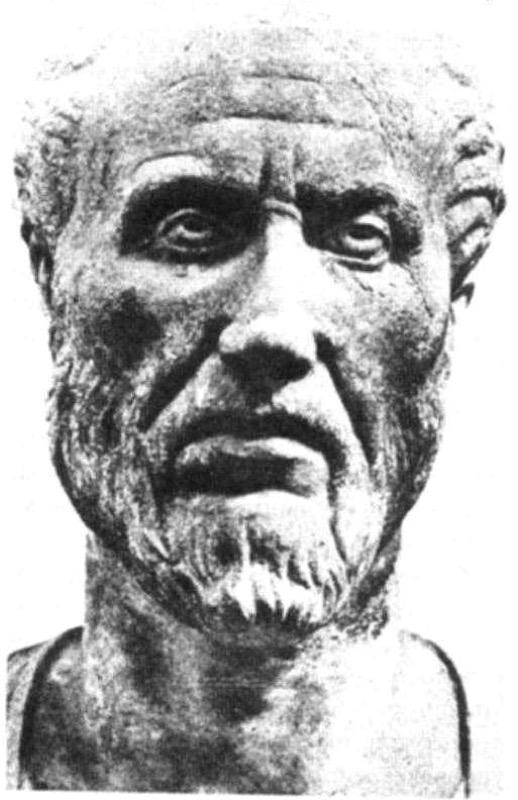
Born in the Egyptian city of Lycopolis, Plotinus studied in Alexandria before teaching in Rome. His student Porphyry later arranged his treatises as the Enneads. The school now called Neoplatonism developed Plato’s thought into a disciplined account of how the many come from the one. Its recurring image is light from the sun: what proceeds depends on its source, while the source is not diminished by giving. “Emanation” is the later name often used for this movement.
Procession describes dependence, not the One breaking apart into pieces. Intellect proceeds from the One, Soul from Intellect, and the world of particular things follows within that order; at no point is the source used up. The many do not explain their own source. Plotinus keeps tracing their existence toward what comes before plurality and cannot be placed alongside other beings as the largest member of the set.
Return follows the same order in the other direction. The soul turns from the scattered pull of particular things, inward and upward, toward the source on which it depends. Procession and return therefore form one movement: reality unfolds from the One, and the soul retraces that dependence. This is Plotinus’s philosophical account of the One, Intellect, and Soul—not revealed or devotional God-language, and not a claim of modern physics.
Words used here
Plain meanings for words on this page.
the One (Plotinus)
In the philosophy of Plotinus, the One is the source of all that is—beyond ordinary naming, not a person among persons, and not a pile of things. Everything else, in this school, flows from it without emptying it.
emanation
A picture of reality flowing from a source the way light flows from the sun: what comes after depends on the source, while the source is not used up. In Plotinus, this is a philosophical claim about the One, Intellect, and Soul—not a laboratory description, and not automatically the same as Kabbalah’s later map of sefirot.
Neoplatonism
A later name for the school that developed Plato’s thought in the Roman world, especially around Plotinus in the third century CE. It is philosophy taught in a circle of students, not a church, though later Jewish, Christian, and Islamic thinkers read it.
Featured connections
Where Plotinus meets other voices
PlotinusGod
shared concept
The source beyond being
The One and several major forms of God-language both refuse to place the ultimate merely alongside the finite things that depend on it.
Plotinus places the One at the source of all reality, beyond the plurality and ordinary naming of beings. This philosophical account belongs beside other ways of speaking about what is ultimate because it asks what everything depends on and how the soul can return toward that source.
Where they differ
Plotinus describes procession from the One through Intellect and Soul, and the soul’s ascent back through that order. Covenant, Qur’anic revelation, Advaita, and Spinoza’s substance each give the source a different meaning and a different path of approach.
PlotinusMeister Eckhart
parallel
Language at the edge of the source
Each links inward transformation with an approach to a source beyond the images and concepts by which it is usually named.
Plotinus and Eckhart both press language toward a source that ordinary names cannot contain. The comparison brings philosophical ascent beside Christian detachment: in each, the soul turns from scattered attachments toward a deeper unity.
Where they differ
Plotinus develops the One, Intellect, and Soul within late ancient philosophy. Eckhart preaches the Godhead through Trinity, incarnation, grace, and prayer; the broad history of Christian Platonism does not by itself establish a direct line from Plotinus to Eckhart’s particular formulations.
PlotinusBaruch Spinoza
contrast
Procession from the One, expression as modes
Neither begins with finite things as self-sufficient realities.
The comparison turns on two different structures of dependence. Plotinus traces an ordered procession from the One; Spinoza understands finite things as modes of one infinite substance.
Where they differ
Plotinus’s One remains beyond the procession of Intellect and Soul; Spinoza’s God or Nature is substance expressed through attributes and modes.
PlotinusKabbalah
parallel
Procession beside the sefirot
In each account, differentiation depends on a source that is not depleted by what proceeds from it.
A source that remains undiminished while differentiated reality unfolds from it gives Plotinus and Kabbalah a precise point of comparison. The historical study of Neoplatonic currents in Jewish thought does not reduce either account to the other.
Where they differ
Plotinus orders procession through the One, Intellect, and Soul; the sefirot belong to Jewish scripture, prayer, and symbolic interpretation.
Continue from here
Open a related page.
God
Idea
Meister Eckhart
Person
Baruch Spinoza
Person
Sources
What this reading rests on
The Enneads
original work
Primary treatises for Plotinus’s account of the One, Intellect, Soul, procession, and return.
Plotinus – Stanford Encyclopedia of Philosophy
encyclopedia
Scholarly orientation for Plotinus’s life, philosophical system, the Enneads, and later influence.