Person
Adi Shankara
classical teacher of Advaita Vedanta
Shankara’s teaching begins from a radical claim: the deepest Self is not separate from ultimate reality. The Indian philosopher and teacher, traditionally dated to the eighth century CE, became the classical voice of Advaita Vedanta. In this Hindu school, the Self is called Atman and ultimate reality Brahman. “Advaita” means non-dual: not two.
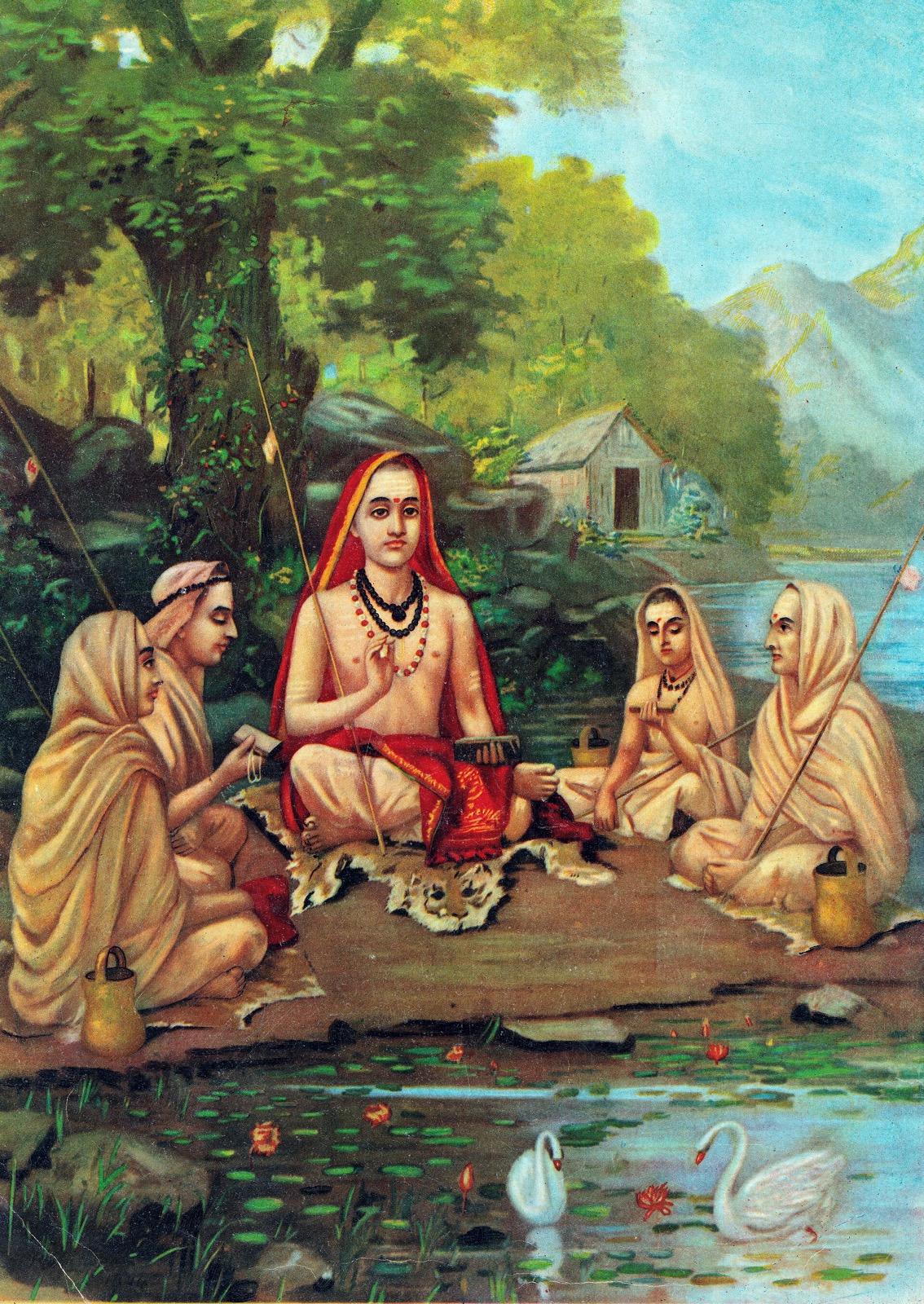
Shankara pursued this inquiry through argument and commentary. He wrote on the Upanishads—late Vedic dialogues about self and reality—the Bhagavad Gita, and the Brahma Sutras. The Upadesasahasri, or “A Thousand Teachings,” is often treated as a work in his own teaching voice. Stories of miracles and a journey across India belong to later legend; historians distinguish them from the commentarial record. Even the exact years of his life remain debated.
Advaita calls the appearance of one reality as many selves and objects maya. The word does not dismiss the world as a cheap trick or make other people unreal. It asks what the world of separation is an appearance of, and whether ordinary division reveals the deepest level of things. Shankara’s recurring movement is from taking plurality as final toward recognizing Atman and Brahman as not two. That is Advaita’s account within the wider diversity of Hindu thought, not a summary of Hinduism as a whole.
Words used here
Plain meanings for words on this page.
Advaita Vedanta
A school of Hindu philosophy that teaches that the deepest Self and ultimate reality are not fundamentally separate. This view is often called non-duality.
A little deeper
“Advaita” means “not two.” Vedanta refers to teachings associated with the later portion of the Vedic tradition, especially the Upanishads. Advaita does not deny ordinary experience; it asks what remains when the sense of separation is examined.
Brahman
In Advaita Vedanta and related Hindu traditions, Brahman names ultimate reality: not a separate object inside the universe, but the fundamental reality of which everything is an expression.
Atman
In many Hindu philosophical contexts, Atman names the deepest Self. In Advaita, this Self is understood as not separate from Brahman.
maya
In Advaita Vedanta, maya names the appearance by which one reality is experienced as a world of many things and many selves. It is not a claim that nothing is happening, and it is not a license to treat other people as fake.
A little deeper
Popular speech often hears “illusion” and stops. Classical Advaita is more precise: ordinary experience is not denied; it is asked what it is an appearance of. Other Hindu schools use the word differently.
non-duality
The idea that the separation we normally experience between “me” and “everything else” is not the deepest level of reality.
Featured connections
Where Adi Shankara meets other voices
Adi ShankaraMeister Eckhart
parallel
When detachment opens beyond the separate self
Both join detachment to transformed knowing: Shankara’s discriminating knowledge frees through recognition of Atman as Brahman, while Eckhart’s detached soul receives the birth of the Word within Christian life.
Shankara and Eckhart both ask how a person’s way of knowing changes when grasping and self-will lose their authority. Shankara answers through knowledge of the Self that liberates; Eckhart through Christian detachment in which the Word is born in the soul.
Where they differ
Shankara teaches liberating knowledge that Atman and Brahman are non-dual; Eckhart preaches the birth of the Word in the soul within Christian creation, Trinity, grace, and prayer.
Adi ShankaraAdvaita Vedanta
historical relationship
The teacher who gave Advaita classical form
Advaita’s roots reach into earlier Upanishadic and Vedantic inquiry, yet Shankara gave the school a lasting argumentative and commentarial shape. Through works on the Upanishads, Bhagavad Gita, and Brahma Sutras, he made knowledge of the non-duality of Atman and Brahman central to a disciplined path of liberation.
Continue from here
Open a related page.
Advaita Vedanta
Tradition
Meister Eckhart
Person
Self
Idea
Ramana Maharshi
Person
Sources
What this reading rests on
Upadesasahasri (A Thousand Teachings)
original work
A primary teaching work often treated as Shankara’s own voice on Self, knowledge, and non-duality.
Shankara – Encyclopaedia Britannica
encyclopedia
Secondary orientation for Shankara’s debated dating, historical setting, works, and place in Advaita.
Advaita Vedanta
encyclopedia
Scholarly orientation for the Advaita account of Atman, Brahman, and non-duality.