Person
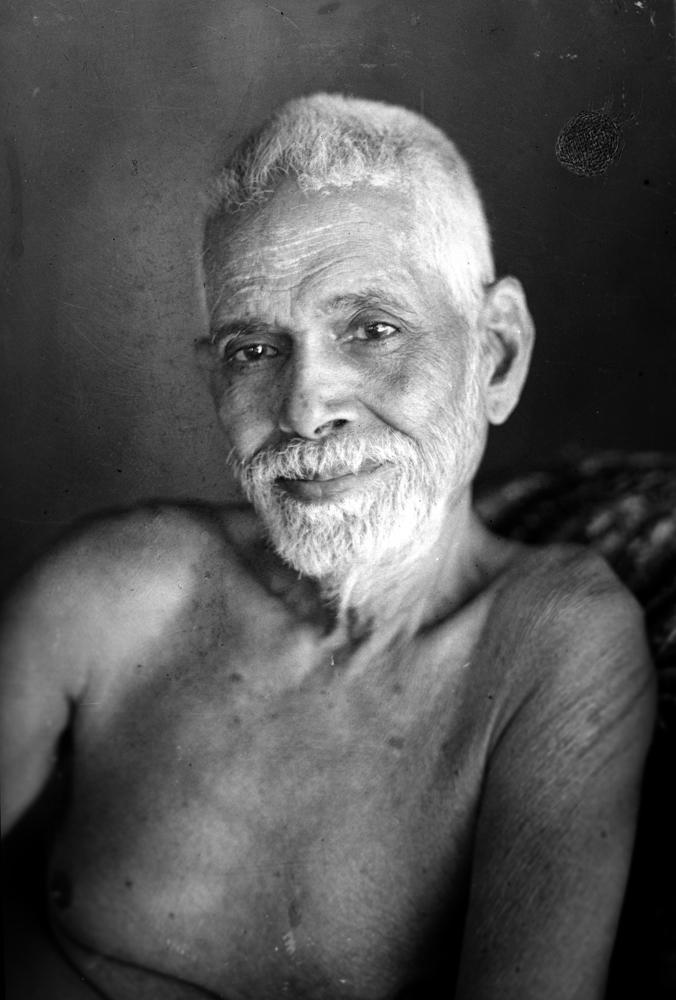
Ramana Maharshi
Ramana Maharshi was an Indian spiritual teacher whose self-inquiry turns a familiar question back on the questioner. Instead of asking which name, role, memory, or belief best describes you, the inquiry asks where the sense of “I” comes from and what remains when its usual descriptions fall away.
The movement is subtle but decisive. A thought, feeling, or perception appears, and almost immediately an “I” claims it: I think, I fear, I see. Ramana directs attention toward that claimant rather than toward the changing content it gathers around itself. In Who Am I?, this inquiry follows the “I”-thought toward its source instead of trying to furnish it with a better spiritual identity.
Ramana’s teaching draws on Advaita Vedanta, a Hindu philosophical tradition that understands the deepest Self, Atman, as not separate from Brahman, ultimate reality. The inquiry therefore does not end by saying that no Self can be found. It opens toward a non-dual claim: the separate person is not the deepest account of what one is. This keeps Ramana close to Buddhist investigation at the point where ordinary identity is questioned, while Advaita’s answer remains its own.
Words used here
Plain meanings for words on this page.
Advaita Vedanta
A school of Hindu philosophy that teaches that the deepest Self and ultimate reality are not fundamentally separate. This view is often called non-duality.
A little deeper
“Advaita” means “not two.” Vedanta refers to teachings associated with the later portion of the Vedic tradition, especially the Upanishads. Advaita does not deny ordinary experience; it asks what remains when the sense of separation is examined.
non-duality
The idea that the separation we normally experience between “me” and “everything else” is not the deepest level of reality.
Atman
In many Hindu philosophical contexts, Atman names the deepest Self. In Advaita, this Self is understood as not separate from Brahman.
Brahman
In Advaita Vedanta and related Hindu traditions, Brahman names ultimate reality: not a separate object inside the universe, but the fundamental reality of which everything is an expression.
Featured connections
Where Ramana Maharshi meets other voices
Ramana MaharshiSiddhartha Gautama
parallel
The inquiry before the answer
Ordinary identity becomes a question rather than the starting assumption.
The comparison is strongest in the act of inquiry: each interrupts the reflex to accept the familiar “I” without examination, then follows that interruption in a different direction.
Where they differ
Their answers are not interchangeable: early Buddhism releases every aggregate from the claim of permanent self, while Ramana’s Advaita turns toward the deepest Self as ultimate reality.
Ramana MaharshiNot-self
contrast
Where the inquiry divides
The meeting point is freedom from taking the familiar person as self-evident.
Placed beside Ramana, not-self marks the point where a shared loosening of identification becomes a genuine disagreement about what the inquiry reveals.
Where they differ
Not-self releases the aggregates from the claim of permanent self; Ramana’s Advaita affirms Atman as not separate from ultimate reality.
Ramana MaharshiIdentification
shared concept
Turning toward the one who claims
A thought, role, or mood becomes identification when it is claimed as “me.” Ramana’s self-inquiry turns attention from the changing experience toward the “I” that claims it, then asks where that claimant comes from.
Ramana MaharshiCarl Jung
similar language
Beyond the everyday ego
Each places the familiar “I” within a larger account—Jung within the whole psyche, Ramana within a non-dual inquiry into Self and ultimate reality.
Jung and Advaita both challenge the assumption that the everyday ego is the whole of who we are. Jung’s Self names psychological wholeness; Advaita’s Self names ultimate reality, understood as not separate from Brahman. The shared word makes the comparison vivid, but it does not make the claims identical.
Where they differ
Jung is describing the wholeness of the psyche. Advaita makes a metaphysical claim that the deepest Self and ultimate reality are not fundamentally separate.
Continue from here
Open a related page.
Identification
Idea
Self
Idea
Jesus of Nazareth
Person
Adi Shankara
Person
Sources
What this reading rests on
Who Am I? (Nan Yar?)
original work
Primary short text in which self-inquiry follows the “I”-thought toward its source rather than treating body, thought, and personal identity as the final answer.
Advaita Vedanta
encyclopedia
Secondary scholarly orientation for the Advaita claim that Atman, the deepest Self, is not separate from Brahman, ultimate reality.