Tradition
Kabbalah
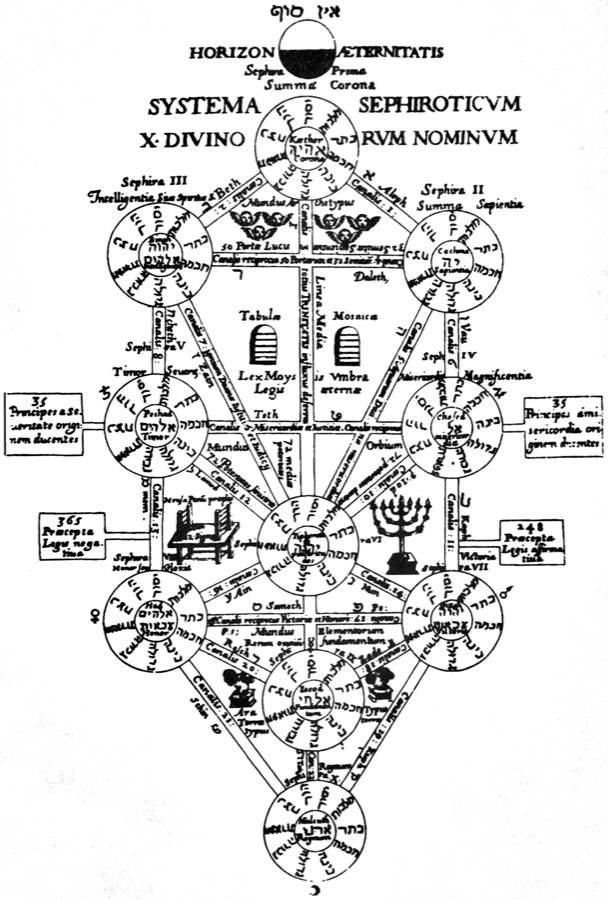
How can the God who exceeds every name become present in a world of names and forms? Kabbalah is a family of Jewish mystical traditions that enters this question through Torah, prayer, and symbolic interpretation. It speaks of Ein Sof—God without end—and of the sefirot, ten interrelated ways through which divine life is understood to unfold toward creation. The familiar Tree of Life gives that relationship a visible form.
Kabbalah has never been one book or one unchanging school. The Zohar, a body of Aramaic commentary on the Torah that appeared in late thirteenth-century Spain, became central to much later Kabbalistic thought. Jewish tradition attributes it to the second-century sage Shimon bar Yochai, while historians associate its composition with medieval Spain, especially Moses de León. In sixteenth-century Safed, teachings linked to Isaac Luria described creation through a drama of divine contraction, shattered vessels, and repair. These developments belong within Jewish religious life, where mystical reflection can deepen the meaning of scripture and commandment rather than replace them.
Its recurring movement runs from hidden infinity into differentiated life and back toward restored relation. The sefirot give Kabbalists a language for contemplating how unity can appear through mercy, judgment, beauty, and presence without becoming ten separate gods. Later Christian thinkers adopted and reshaped parts of this vocabulary as Christian Cabala; the seventeenth-century image on this page belongs to that reception, not to the medieval Jewish origin of the tradition. Modern occult and popular versions add further layers. Plotinus’s account of emanation offers a genuine philosophical parallel, but Ein Sof and the sefirot remain a Jewish mystical response shaped by Torah and the God of Israel.
Words used here
Plain meanings for words on this page.
Kabbalah
A Jewish mystical tradition that developed ways of speaking about how the infinite relates to the created world. It includes medieval books such as the Zohar, later Lurianic teaching, and many schools. It is not all of Judaism, and it is not a celebrity wellness brand.
Ein Sof
In Kabbalah, Ein Sof names God as infinite—without end, beyond the images and names we can hold. The sefirot are then described as ways that infinite relates to a world of form. Ein Sof is not a nickname for Plotinus’s One, though later readers hear a rhyme.
sefirot
In Kabbalah, the sefirot are ten emanations, attributes, or vessels through which the infinite is said to relate to creation. They are often drawn as the Tree of Life. They are a Jewish mystical map, not a scientific chart, and not ten gods.
Featured connections
Where Kabbalah meets other voices
KabbalahJudaism
historical relationship
A Jewish mystical stream
Kabbalah and wider Jewish life share scripture, prayer, covenant, and devotion to the God of Israel.
Kabbalah developed within Jewish life, drawing Torah, prayer, commandment, and the God of Israel into sustained reflection on how the infinite becomes present in creation. It is one important current within a much wider and internally diverse tradition.
Where they differ
Jewish life does not depend on the sefirot or Kabbalistic accounts of emanation. Kabbalah develops a particular mystical vocabulary within Judaism rather than defining the tradition as a whole.
KabbalahTree of Life
shared concept
Ten sefirot in relation
The Kabbalistic Tree of Life arranges ten sefirot—divine emanations, attributes, or vessels—into a map of relation between Ein Sof, the Infinite, and the created world.
KabbalahPlotinus
parallel
Procession beside the sefirot
In each account, differentiation depends on a source that is not depleted by what proceeds from it.
A source that remains undiminished while differentiated reality unfolds from it gives Plotinus and Kabbalah a precise point of comparison. The historical study of Neoplatonic currents in Jewish thought does not reduce either account to the other.
Where they differ
Plotinus orders procession through the One, Intellect, and Soul; the sefirot belong to Jewish scripture, prayer, and symbolic interpretation.
Continue from here
Open a related page.
Tree of Life
Idea
Judaism
Tradition
Plotinus
Person
Sources
What this reading rests on
Kabbala – Encyclopaedia Britannica
encyclopedia
Secondary orientation for Kabbalah’s Jewish setting, historical development, central vocabulary, and diversity of schools.
The Zohar
primary text
A central body of medieval Jewish mystical commentary on Torah, approached with both its traditional attribution and its historical association with thirteenth-century Spain in view.