Concept
Tree of Life
A Jewish mystical map of infinite and world
How can an infinite God relate to a finite world? Kabbalah, a Jewish mystical tradition, approaches that question through ten sefirot: emanations, attributes, or vessels through which the divine is said to become present in creation. Drawn together as the Tree of Life, they form a map between Ein Sof—God without end—and the world of form.
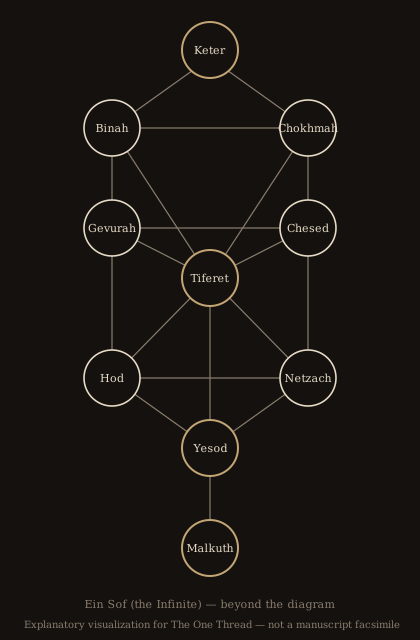
Later diagrams arrange the sefirot in a pattern of relationships, often across three pillars. Qualities such as overflowing kindness, strength, beauty, and kingdom do not stand as ten separate gods; together they give Kabbalists a language for contemplating divine life, creation, and the human response. Ein Sof is not simply another circle at the top of the chart. The diagram begins where ordinary images of God reach their limit.
Plotinus described reality as proceeding from the One, and other traditions also picture a world sustained by a source beyond its separate forms. Kabbalah makes that movement visible in a distinct Jewish vocabulary, shaped by Torah, the God of Israel, and centuries of mystical interpretation. The recurring question is shared; the sefirot are not interchangeable with Plotinus’s One or with a scientific account of the universe.
The English name also invites comparison with the tree in Genesis, the Norse world-tree Yggdrasil, and the Bodhi tree associated with the Buddha’s awakening. Trees repeatedly become images of life, connection, and worlds held together. That is a meaningful pattern to notice, but each tree belongs first to its own story. Here, the Tree of Life means the Kabbalistic map of the sefirot.
Words used here
Plain meanings for words on this page.
sefirot
In Kabbalah, the sefirot are ten emanations, attributes, or vessels through which the infinite is said to relate to creation. They are often drawn as the Tree of Life. They are a Jewish mystical map, not a scientific chart, and not ten gods.
Ein Sof
In Kabbalah, Ein Sof names God as infinite—without end, beyond the images and names we can hold. The sefirot are then described as ways that infinite relates to a world of form. Ein Sof is not a nickname for Plotinus’s One, though later readers hear a rhyme.
Kabbalah
A Jewish mystical tradition that developed ways of speaking about how the infinite relates to the created world. It includes medieval books such as the Zohar, later Lurianic teaching, and many schools. It is not all of Judaism, and it is not a celebrity wellness brand.
Featured connections
Where Tree of Life meets other voices
Tree of LifeKabbalah
shared concept
Ten sefirot in relation
The Kabbalistic Tree of Life arranges ten sefirot—divine emanations, attributes, or vessels—into a map of relation between Ein Sof, the Infinite, and the created world.
Continue from here
Open a related page.
Kabbalah
Tradition
Judaism
Tradition
Plotinus
Person
Sources
What this reading rests on
Kabbala – Encyclopaedia Britannica
encyclopedia
Historical and scholarly orientation for Ein Sof, the sefirot, and their place in Kabbalistic teaching.
The Zohar
primary text
Central medieval Jewish mystical literature in which the relationships later mapped through sefirotic symbolism are developed.