Teaching
Book of Enoch
1 Enoch—scripture in Ethiopia, expansion elsewhere
Read through
Optional. Marks sentences on this page only — it never rewrites the reading.
The Book of Enoch, often called 1 Enoch, is a composite ancient Jewish work. One of its oldest major sections, the Book of the Watchers, tells of angels who descend, take human wives, and teach arts the story treats as forbidden; violence spreads through their offspring, and the world moves toward the flood. Across the larger work, Enoch becomes a witness and messenger who is carried through palaces of fire and the storehouses of the winds, shown a cosmic order in which judgment and hope reach beyond the disorder below.
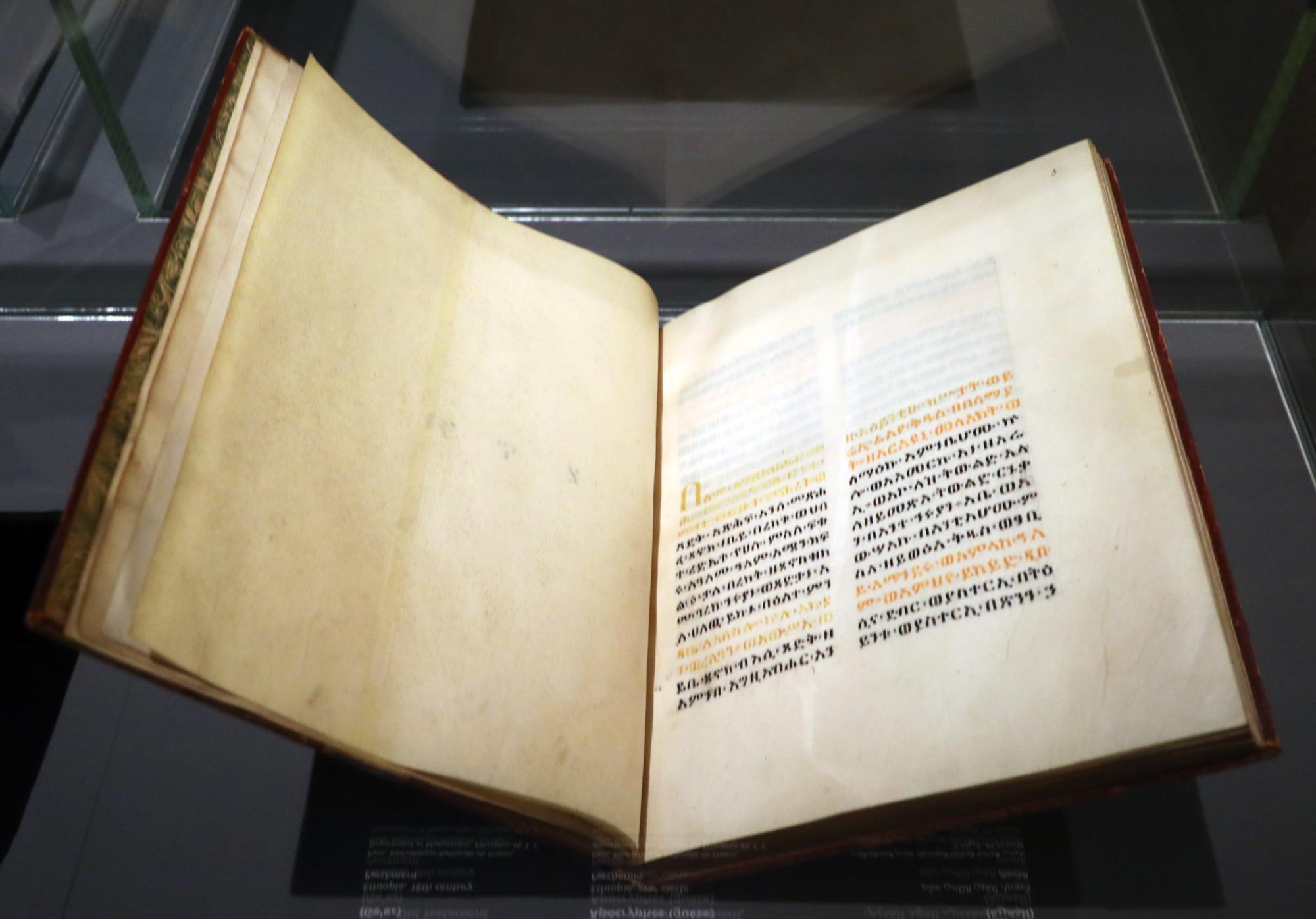
This is not a book written all at once. Scholars usually date the Book of the Watchers, one of its oldest major sections, to the third century BCE, with other sections composed later. Aramaic fragments found among the Dead Sea Scrolls place Enochic literature firmly within Second Temple Judaism, while the complete form of 1 Enoch survives in Ge’ez. The Ethiopian Orthodox Church continues to receive it as scripture, although it is absent from the Jewish Tanakh and most Christian Bibles. The image here shows an eighteenth-century Ethiopian manuscript: a witness to that long reception, not Enoch’s own handwriting.
Its path through religious communities is as revealing as its visions. The New Testament letter of Jude quotes a prophecy closely matching 1 Enoch, showing that early Christians knew Enochic words without showing that every later church accepted the whole work as scripture. Two other writings belong to the wider Enoch tradition but remain separate books: 2 Enoch survives mainly in Slavonic, and 3 Enoch is a later Hebrew work associated with Jewish mystical circles.
The deepest tension in 1 Enoch lies within knowledge itself. The Watchers’ forbidden teaching becomes a breach that spreads violence, while Enoch’s heavenly journey reveals an ordered cosmos and gives him a message of judgment and hope. A modern popular reading hears spacecraft, illustrating how a later age can recast ancient visionary language rather than what the work itself claims.
Words used here
Plain meanings for words on this page.
1 Enoch
An ancient Jewish book, also called the Book of Enoch or Ethiopic Enoch, written in Enoch’s name centuries after the Genesis genealogy. It survives complete in Ge’ez, the liturgical language of the Ethiopian Orthodox Church, which still holds it as scripture. Most Jewish and Christian Bibles do not.
A little deeper
Scholars often date the oldest section, the Book of the Watchers, to the third century BCE. Aramaic fragments were found among the Dead Sea Scrolls. Two later works, 2 Enoch and 3 Enoch, are different books, not extra chapters of this one.
Watchers
In 1 Enoch, angels charged with watching over the earth who descend, take human wives, and teach skills the book treats as forbidden: metalwork, spells, and reading of the sky. Their story expands a brief, puzzling passage in Genesis 6. It is not automatically the later Christian story of Satan’s fall.
revelation
Knowledge a religious tradition understands as disclosed or given rather than reached by human reasoning alone—for example through divine speech, scripture, prophecy, vision, or inner illumination.
A little deeper
A claimed revelation is received and interpreted within a community: texts are preserved, visions are tested, and meanings are argued. Reason, tradition, and experience may all take part, while communities continue to disagree about what counts as revelation and what authority it carries.
Featured connections
Where Book of Enoch meets other voices
Book of EnochEnoch
later interpretation
From brief ancestor to heavenly seer
Genesis gives Enoch only a few lines, ending with the unexplained statement that God took him. Centuries later, Jewish writers composing in his name made him a traveler through the heavens and a messenger of judgment to the Watchers. The later work expands the earlier figure through visionary literature.
Book of EnochDead Sea Scrolls
historical relationship
Enoch preserved at Qumran
Aramaic fragments of several parts of 1 Enoch were found among the Dead Sea Scrolls. Their presence places Enochic visions of the Watchers, judgment, and the ordered heavens within surviving Jewish literature of the Second Temple period, centuries before most later Christian decisions about canon.
Book of EnochWatchers
shared concept
Descent, forbidden teaching, judgment
The Book of the Watchers develops the story of angels who descend to Hermon, take human wives, teach forbidden arts, and face judgment through Enoch’s message. This is the fullest ancient narrative setting for the Watchers and their violent offspring.
Continue from here
Open a related page.
Enoch
Person
Watchers
Idea
Ezekiel
Person
Revelation
Idea
Sources
What this reading rests on
1 Enoch (Book of the Watchers and related sections)
primary text
Primary text for the Watchers’ descent and forbidden teaching, Enoch’s mission of judgment, and his journey through the ordered heavens.
Genesis 5:21–24
primary text
The brief biblical notice that Enoch walked with God and was taken, from which the later visionary tradition grows.
Jude 14–15
primary text
A New Testament quotation closely matching 1 Enoch, showing early Christian familiarity without establishing later canonization of the whole book.
First Book of Enoch – Encyclopaedia Britannica
encyclopedia
Secondary orientation for the work’s composition, contents, Ethiopian canon status, and reception beyond Ethiopia.