Person
Enoch
A few biblical lines, a world of later vision
Read through
Optional. Marks sentences on this page only — it never rewrites the reading.
Genesis gives Enoch only a few lines, yet those lines opened into a far larger tradition of heavenly vision. He appears in the genealogy before the flood as the son of Jared, the father of Methuselah, and the great-grandfather of Noah. Then the usual rhythm of birth and death breaks: Enoch walks with God, and God takes him. That unexplained departure opens a recurring question about knowledge said to come from beyond ordinary human reach.
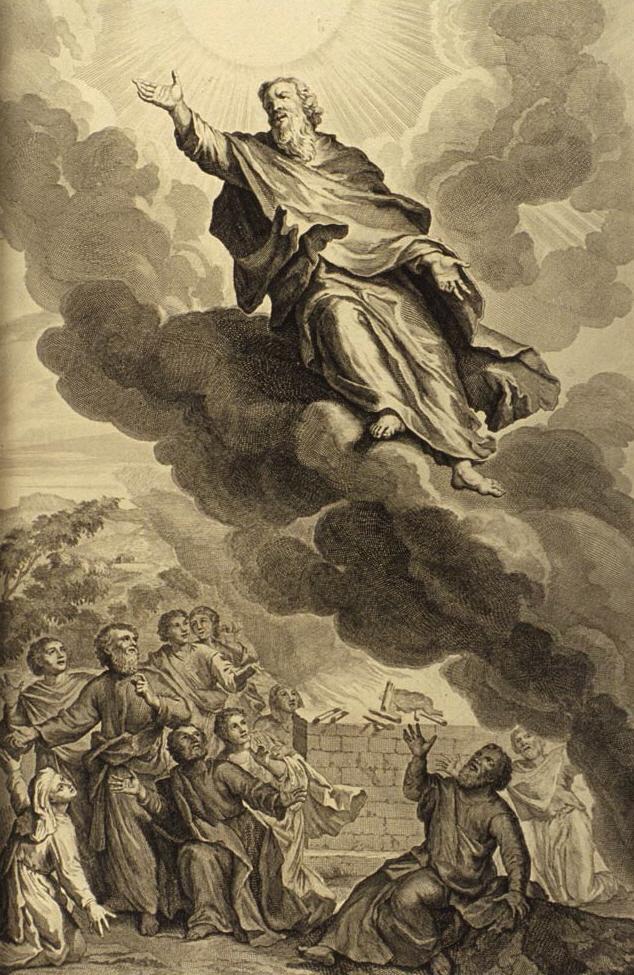
This is the Enoch of Genesis 5, the seventh figure from Adam in that genealogy, not the earlier Enoch named as Cain’s son. The chapter says so little about him that its silence becomes part of his force. Traditional Jewish and Christian readers have often understood his taking as an escape from death, especially because the surrounding genealogy repeatedly ends with the words “and he died.” The eighteenth-century illustration belongs to that long afterlife of interpretation: it imagines the taking but cannot show us the event itself.
Centuries later, between the third and first centuries BCE, Jewish writers composed visionary works in Enoch’s name. In 1 Enoch he travels through the heavens, sees the ordered regions of the cosmos, and carries judgment to the Watchers—angels whose descent and forbidden teaching have thrown the world into disorder. The nearly silent ancestor has become a seer and messenger, a figure through whom hidden knowledge can be disclosed.
The sparse ancestor becomes a vehicle for visions of hidden order. Genesis supplies the arresting absence; later Jewish literature asks what he might have seen. Some modern readers treat the heavenly journey as a memory of visitors from the sky. The idea belongs to the text’s modern reception, while 1 Enoch itself speaks in the world of Second Temple Jewish vision and revelation. The layers need not be confused for the enduring question to remain vivid: what kind of knowledge can a human being receive, and how does a community decide what that vision means?
Words used here
Plain meanings for words on this page.
1 Enoch
An ancient Jewish book, also called the Book of Enoch or Ethiopic Enoch, written in Enoch’s name centuries after the Genesis genealogy. It survives complete in Ge’ez, the liturgical language of the Ethiopian Orthodox Church, which still holds it as scripture. Most Jewish and Christian Bibles do not.
A little deeper
Scholars often date the oldest section, the Book of the Watchers, to the third century BCE. Aramaic fragments were found among the Dead Sea Scrolls. Two later works, 2 Enoch and 3 Enoch, are different books, not extra chapters of this one.
prophet
In Jewish, Christian, and Islamic settings, a prophet is a figure who speaks for God—or who bears a message that interrupts ordinary political and religious assumptions. Prophecy can include vision, poetry, warning, law, and hope.
A little deeper
“Prophet” in academic reading can also name a literary role within scripture. Strange vision can be read as history, as genre, as inner image, or as modern speculation—the text itself does not decide which reading you must take.
revelation
Knowledge a religious tradition understands as disclosed or given rather than reached by human reasoning alone—for example through divine speech, scripture, prophecy, vision, or inner illumination.
A little deeper
A claimed revelation is received and interpreted within a community: texts are preserved, visions are tested, and meanings are argued. Reason, tradition, and experience may all take part, while communities continue to disagree about what counts as revelation and what authority it carries.
Featured connections
Where Enoch meets other voices
EnochEzekiel
parallel
Vision that becomes a commission
Each presents hidden order through fire, heavenly beings, and a seer who receives knowledge and is charged to carry a message.
Ezekiel and the Enoch of 1 Enoch both encounter an ordered heavenly world through overwhelming vision. In each account, seeing leads to responsibility: Ezekiel is sent to speak to Israel in exile, while Enoch carries judgment to the Watchers.
Where they differ
Ezekiel’s vision belongs to a prophetic book in the Hebrew Bible and addresses a people in exile. 1 Enoch is a later work written in an ancestor’s name, received as scripture in Ethiopian Orthodoxy but outside most other canons.
EnochBook of Enoch
later interpretation
From brief ancestor to heavenly seer
Genesis gives Enoch only a few lines, ending with the unexplained statement that God took him. Centuries later, Jewish writers composing in his name made him a traveler through the heavens and a messenger of judgment to the Watchers. The later work expands the earlier figure through visionary literature.
Continue from here
Open a related page.
Book of Enoch
Teaching
Watchers
Idea
Ezekiel
Person
Judaism
Tradition
Sources
What this reading rests on
Genesis 5:21–24
primary text
The brief biblical account of Enoch’s life and unexplained taking, from which the later visionary tradition grows.
1 Enoch (Book of the Watchers and related sections)
primary text
The later Jewish work that recasts the sparse Genesis figure as a heavenly traveler, seer, and messenger to the Watchers.
First Book of Enoch – Encyclopaedia Britannica
encyclopedia
Secondary orientation for the composition, contents, and reception of the books written in Enoch’s name.