Teaching
Tao Te Ching
Read through
Optional. Marks sentences on this page only — it never rewrites the reading.
Water does not need to become rigid to endure, and a vessel is useful because it has room within it. The Tao Te Ching—also spelled Daodejing—is a short Chinese classic, traditionally attributed to Laozi, that returns to images like these when direct definitions reach their limit. It draws the reader toward dao, the Way, by asking what can be known without being captured by a name.
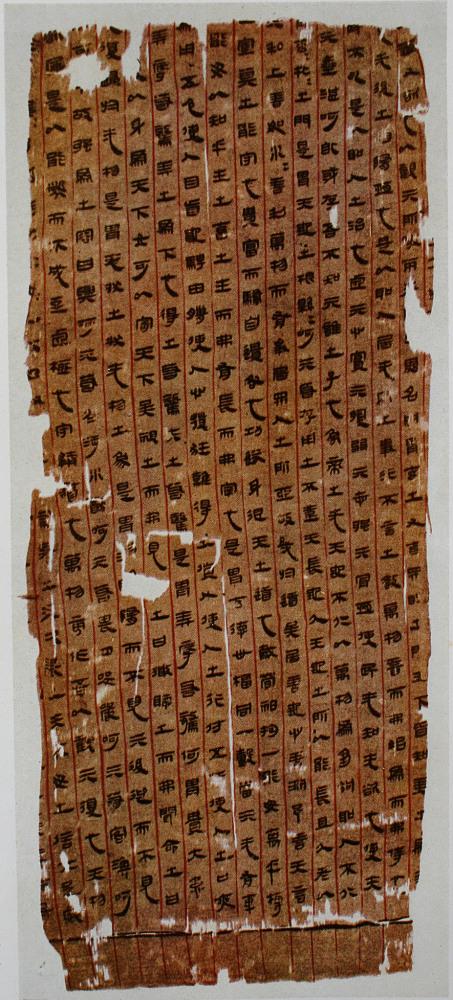
The naming paradox appears immediately. In one familiar English rendering, the Way that can be told is not the eternal Way. Translations vary, yet the tension remains: dao is often translated as the Way, while the text does not offer it as one more thing to define and possess. Names let us speak about the world, but the Way from which named things emerge cannot be exhausted by them. The text therefore works through poetry, image, and paradox rather than building a system from fixed definitions.
Water becomes an image of strength without rigidity: soft and yielding, yet able to wear away stone. In another familiar image, worded differently across translations, emptiness that makes the cup useful suggests that what is absent can be part of how something works. Simplicity follows the same movement, loosening the urge to add, grasp, and control. The Taoist term wu wei is often rendered as non-forcing action—not doing nothing, but acting in responsive accord with the flowing order of things rather than straining against it.
This movement can speak to modern questions about reality because it unsettles the assumption that what is most real must be something we can name, hold, or control. The Tao Te Ching reaches that insight through poetry, conduct, and attention to the difference between force and responsive action. Modern physics asks different questions with experimental and mathematical tools, so the resonance belongs to philosophy rather than historical anticipation. Readers meet the Taoist insight as poetry, scripture, and philosophy; dao, de—the virtue or power of alignment—and wu wei each carry more than one shade of meaning.
Words used here
Plain meanings for words on this page.
Tao (Dao)
The central term in Taoist teaching, often translated as the Way—the source, pattern, or flowing order of reality that precedes names and cannot be fully captured in words.
A little deeper
Taoist texts speak in paradox and image because the Way is said to be beyond rigid definition. Dao names a source and flowing order, in a different register from a personal god or a laboratory object.
Taoism
A family of Chinese traditions associated with the Tao Te Ching, Zhuangzi, and later religious and philosophical developments. It speaks of the Way, naturalness, and alignment with the flowing order of things.
A little deeper
Philosophical Taoism and religious Taoism are related, and they still do different jobs. Texts, lineages, and practices diverge across history.
Featured connections
Where Tao Te Ching meets other voices
Tao Te ChingLaozi
historical relationship
The sage named by the text
Tradition gives Laozi’s name to the Tao Te Ching and remembers him as the sage behind its teaching. The connection is historically important even though the text’s authorship and formation remain debated.
Tao Te ChingShow the pattern
shared concept
When names reach their limit
The Tao Te Ching makes the limits of naming central to its approach to dao. From there, a wider pattern becomes visible: very different traditions ask whether words disclose what is most real or mark the point where direct definition begins to fail.
Continue from here
Open a related page.
Laozi
Person
Taoism
Tradition
Reality
Idea
Sources
What this reading rests on
Tao Te Ching (Daodejing)
primary text
The Daodejing’s own treatment of naming, water, emptiness, simplicity, and wu wei grounds this account of the teaching.