Person
Friedrich Nietzsche
The honesty of dissent
Friedrich Nietzsche (1844–1900) was a German philosopher who refused to speak as though inherited belief still carried an authority he saw it losing. His “death of God” names a crisis in European meaning: what becomes of truth and value when the Christian God no longer serves as their living center?
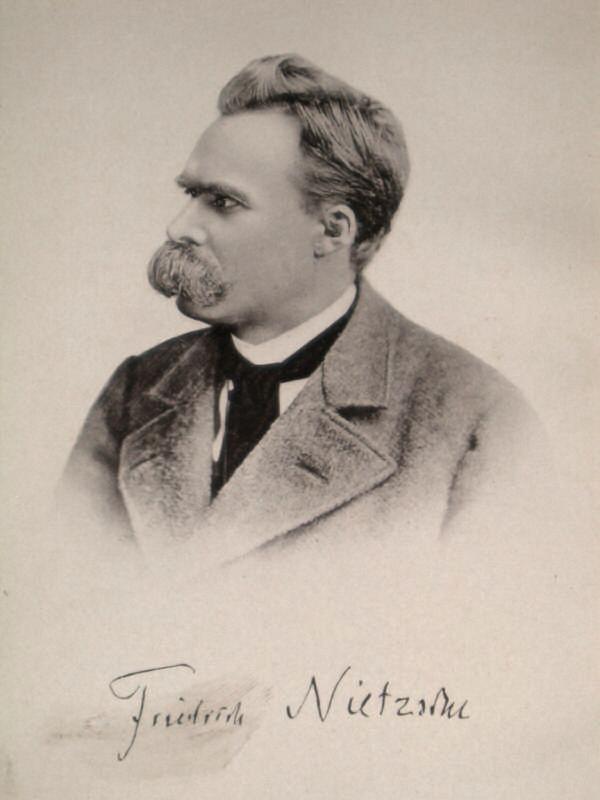
In The Gay Science, the madman’s announcement that “God is dead” describes a cultural event rather than a literal death. Nietzsche’s dissent is demanding because it does not let disbelief end the inquiry. If an old source of meaning no longer commands belief, the question of how to judge, speak truthfully, and live with the consequences becomes more urgent, not less.
Thus Spoke Zarathustra gives that crisis a literary prophet. Nietzsche borrows the name of the Iranian teacher associated with asha and Ahura Mazda, then uses it for a voice attempting to move beyond inherited divisions of good and evil. The choice is an inversion, not a continuation of the Gathas. The same honesty keeps his other ideas from being absorbed too quickly into familiar spiritual categories: eternal recurrence is not Buddhist samsara, and the Übermensch is not an awakened sage. His no refuses the comfort of turning dissent into another version of the belief being challenged.
Words used here
Plain meanings for words on this page.
death of God
Nietzsche’s phrase for a cultural event in which the Christian God no longer functions as the living center of European meaning, even when religious language remains. The phrase names a loss of inherited certainty and the problem of how values survive after it.
Zoroaster / Zarathustra
The same Iranian teacher under two names: Zarathustra in his own language, Zoroaster in Greek. He is remembered as the prophet of a religion that worships Ahura Mazda—the Wise Lord—and teaches asha, truth or right order. Dates for his life are uncertain. He is not the character in Nietzsche’s book Thus Spoke Zarathustra.
Featured connections
Where Friedrich Nietzsche meets other voices
Friedrich NietzscheGod
contrast
The crisis after God
Religious traditions and Nietzsche both treat the question of God as inseparable from how a culture understands truth, value, and the shape of a life.
Nietzsche places God-language under the pressure of a modern European culture that has lost confidence in its Christian center while continuing to live by inherited values. His diagnosis asks what can orient truth and meaning when that authority no longer commands belief.
Where they differ
Covenant, tawhid, Brahman, Ahura Mazda, and the One name differing positive accounts of what is ultimate. Nietzsche’s death of God diagnoses the collapse of inherited Christian authority in modern Europe and the task of valuing that follows.
Friedrich NietzscheZoroaster
contrast
An ancient name recast
Both the Gathic prophet and Nietzsche’s literary figure make moral orientation a matter of how an entire life is shaped.
Nietzsche deliberately gives the name Zarathustra to the literary teacher of Thus Spoke Zarathustra. The historical Zarathustra is remembered through the Gathas as a prophet of Ahura Mazda and asha; Nietzsche recasts the name for a modern critique of inherited morality after the death of God.
Where they differ
The Gathas call hearers toward Ahura Mazda, asha, and resistance to the lie. Thus Spoke Zarathustra is nineteenth-century philosophical literature that uses the ancient name to challenge inherited values, not to continue Zoroastrian teaching.
Continue from here
Open a related page.
God
Idea
Zoroaster
Person
Ethics
Idea
Sources
What this reading rests on
The Gay Science (Die fröhliche Wissenschaft)
original work
Primary source for the madman’s death-of-God announcement and its crisis of meaning.
Thus Spoke Zarathustra
original work
Nietzsche’s literary use of Zarathustra as a voice responding to the death of God.
Friedrich Nietzsche – Stanford Encyclopedia of Philosophy
encyclopedia
Scholarly orientation for Nietzsche’s life, works, and philosophical concerns.